news
Strengthening Household Economic Resilience Through Women-Centred Financial Literacy
22 Dec 2025
In many farming households across Subang and Garut, managing money has long been a daily act of improvisation. Income arrives in irregular bursts—after harvests, day labor, or small trade—while expenses never wait. For the women who quietly hold these households together, financial decisions are often made in survival mode, with little space to plan, save, or invest for the future.
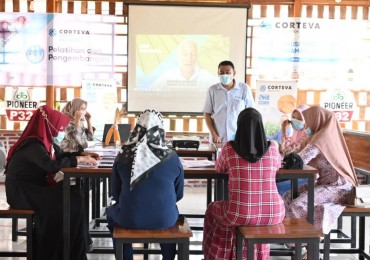
The PERMATA (Pelatihan Rumah Tangga Cermat dan Taat Anggaran) Program, an acronym for Training for Budget-Aware Household, was created to respond to this reality. Implemented by Edufarmers International Foundation with support from Visa, PERMATA works with women from farming households—Ibu Permata—and equips them with simple, practical tools to understand where their money goes, how to plan within uncertainty, and how to begin building financial buffers. Rather than relying on classroom-style instruction, the program is embedded within local communities and led by Kader Permata—trusted women leaders who guide learning through peer discussions, hands-on exercises, and ongoing mentoring.
Over three training batches, PERMATA reached 1,698 women, many of whom were still forming their financial habits. As participants began recording daily expenses, separating household and farming/business funds, and setting small but realistic saving goals, financial management shifted from an abstract concept into a daily practice. For many women, this was the first time money felt manageable rather than overwhelming.
Key Findings
- Practical tools create strong behaviour change: Although theoretical knowledge on finance only show an increase of 9%, the result of monitoring workbooks weekly show 89% of women adopted budgeting practices and 87% consistently recorded expenses.
- Bank Account ownership are high, but there are limited use of formal and digital finance. While 73% of women own bank accounts, only 36% saved regularly in banks and only 25% of women conducted digital transactions. When asked, these women prefer to have cash on hand and feel the money saved weekly are to small to make the trip to banks. Limiting use of digital transactions are also ways for them to manage their expenses.
- Training to build the habits to save and becoming more mindful of spending, allows women to set aside money for future planning. The share of women setting aside money for income-generating activities rose from 17% to 27.6%, indicating growing confidence to reinvest and plan ahead.
The PERMATA story shows that financial resilience does not begin with higher income, but with awareness, intention, and community support. When women are recognized as financial decision-makers and equipped with tools that fit their lived realities, meaningful change follows—even in the most volatile economic conditions. Programs like PERMATA demonstrate how community-led, practical financial literacy can lay the foundation for more resilient households, stronger rural economies, and inclusive growth—one household at a time.
Read the full report here: Visa Permata Report
 Back To List