With Support from Google.org
Advancing Food Security Across Southeast Asia
Across Southeast Asia, smallholder farmers and underserved families face persistent challenges—from declining agricultural productivity and climate vulnerability to malnutrition and limited access to reliable guidance. These issues pose a threat to food security, public health, and rural livelihoods. Edufarmers, a nonprofit organization rooted in Indonesia, addresses these interconnected challenges by equipping farmers with agronomic knowledge, digital tools, and AI-powered support.
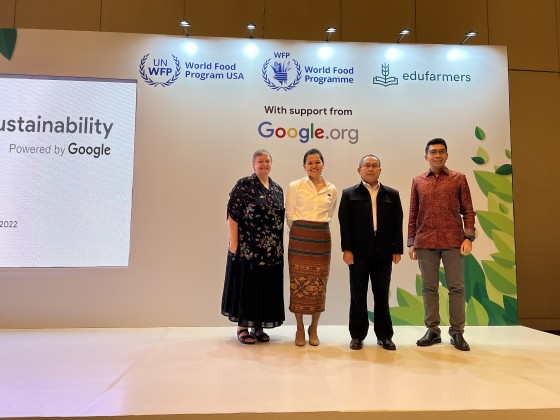
Three years after receiving its first US$724,490 grant in 2022 for the Solve for Sustainability Program from Google.org (access the report here), Edufarmers, through its “Bertani untuk Negeri” has trained 5,694 farmers and 1,441 youth. Its online learning platform Bertani Academy, and short educational videos posted on social media boast more than 2,500 enrollments and 2.7 million views. The intensive training in sustainable farming practices, business acumen, and soft skills aims to boost farmers' productivity and ultimately increase farmers' income.
In 2024, Edufarmers provided a second grant of US$2 million to empower farmers and youth. The initiative, called F.A.R.M. (Fostering A.I. for Resilient Farming and Mitigating Stunting). This next phase introduces two AI-powered solutions—“Pak Dayat” for agronomic advice and “SAKTI” for nutrition guidance—to address key challenges in food production and child malnutrition. Central to this effort is the Plaza Bertani initiative, a community-based agricultural learning ecosystem that integrates farmer training, collective farming, and AI tools like Pak Dayat to scale knowledge transfer and best practices. The F.A.R.M. initiative aims to reach 200,000 smallholder farmers and underserved families across Indonesia, with early pilots showing strong engagement, improved farming outcomes, and adoption among farmers and parents.
Building on these successes, Edufarmers is now expanding its AI-driven solutions to other ASEAN countries, starting with Vietnam and Thailand—regions that face similar agricultural challenges. In August 2025, at the 2nd Regional Policy Convening of AI Ready ASEAN in Kuala Lumpur, Google.org announced a US$3.5 million grant to Edufarmers. This marks the third phase of Edufarmers' growth and its first regional expansion outside Indonesia.
Program Objectives

Deploy and disseminate AI-powered technology for Agriculture and Nutrition

Farmers experience an increase in knowledge and adoption of Good Agricultural Practices, eventually increasing their productivity and income by at least 15%

Parents, teachers, and community health workers in Indonesia are trained using AI-powered tools and gain a 30% increase in nutrition knowledge

Stunting reduction by up to 20% in targeted communities through its AI-enhanced ZeroStunting program.
Program Impact

1441 youth empowered through BUN

5694 farmers empowered through BUN

4,356 farmers empowered through Plaza Bertani

Agronomic AI (Pak Dayat) currently reaches 909 users

Pak Dayat supports more than 8 key crops, especially staple and high-value crops like rice, corn, chili, tomatoes, and potatoes.

SAKTI Nutrition AI has been tested in 250 users
Our Initiatives
Conducting research & producing knowledge
Edufarmers collaborates with Ministry of Education, Culture, Research and Technology (MoECRT), universities, and local communities to pilot new agricultural products and practices, aiming to maximize yields. As of August 2024, Edufarmers have conducted 41 agroeconomic experiments.
Discover our farming modules and research findings
Establishing an online education platform and social media outreach
Sharing the wealth of agricultural knowledge, Edufarmers launched Bertani Academy, a comprehensive online learning platform catering to farmers and aspiring agriculturalists. Expanding its reach, the organization employs compelling short videos disseminated across prominent social media channels like YouTube, Instagram, and TikTok, ensuring that agricultural insights are accessible to all.
Join the learning community at Bertani Academy or watch our educational videos on Youtube
Fostering Co-learning between youth and farmers to increase productivity
To foster a powerful exchange of knowledge between youth and farmers, Edufarmers implements its flagship program Bertani untuk Negeri (BUN). Through immersive 1.5 months training, youth interested in agriculture are trained then work alongside small holder farmers to share modern agricultural practices and business strategies. The hands-on approach not only empowers farmers with tools to improve yields and incomes but also inspire the next generation of farmers.
Learn more on Bertani untuk Negeri Program
Connecting Agri-innovators to transform the agriculture sector
The Agrinnovation Conference serves as a dynamic platform where key players from across the agricultural landscape converge to exchange insights on the latest advancements, forge meaningful connections, and amplify their impact on the industry.
Fostering A.I. for Resilient Farming and Mitigating Stunting (F.A.R.M)
Edufarmers is tackling food security and stunting prevention with two new initiatives. The Plaza Bertani Ecosystem will offer agricultural education, collective farming opportunities, and an AI-powered chatbot to help 80,000 farmers improve their yields and income. Additionally, the platform will provide in-person training to 20,000 smallholder farmers on modern agricultural techniques. To combat stunting, the Nutrition AI and Knowledge Hub will offer educational resources and campaigns on nutrition to 100,000 parents, health cadres, and teachers, while 1,500 children will receive direct nutrition interventions through the "One Day One Egg" program.
Expansion of Agronomic AI to Southeast Asia
With local partners in Thailand and Vietnam, Edufarmers will develop a localised, free AI-powered agronomy chatbot to help 200,000 smallholder farmers diagnose crop diseases through image analysis, provide tailored agronomy advice, and adopt more sustainable agricultural practices. They’ll also train 30,000 farmers and extension workers in Good Agricultural Practices (GAP) to drive long-term impact on productivity, food security, and, in turn, boost their income.