news
How Farmers Learn May Decide Indonesia’s Future of Food
05 Feb 2026
Indonesia’s agricultural sector is increasingly strained. Most farmers are over 50, their children are leaving for cities, yields are stagnant and climate is unpredictable. But here's what years of fieldwork and data taught us: The problem isn't that farmers can't innovate—it's that they've never had sustained support to do so.
Edufarmers built the Farming for the Nation / Bertani Untuk Neg eri (BUN) program to test what happens when motivated youth and experienced farmers are supported to learn together over time.
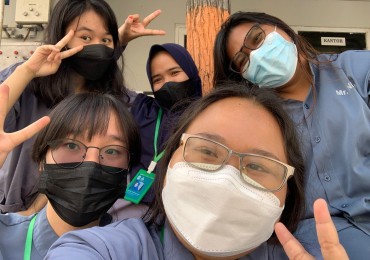
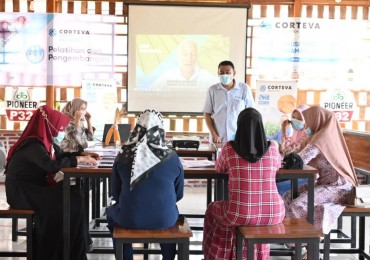
With support from Google.org, and co-investment from JAPFA, Mars, and Indonesia’s Ministry of Education, Culture, Research, and Technology (Kampus Merdeka Program), we embedded young agriculture graduates as field mentors, grounded extension in applied research, and reinforced learning through hybrid digital platforms.
Over four years of implementation, this model allowed us to observe how learning systems operate in real farming conditions.
Our Learnings
Over four years, this model reached 5,694 farmers and 1,436 youth across six provinces. Beyond scale, the program generated important insights into how learning translates into livelihoods.
First, adoption depended more on relationships than on information.
Farmers who met regularly with youth mentors were more willing to test new practices, ask questions, and adjust when problems emerged. This sustained interaction was reflected in a 45% increase in knowledge of good agricultural practices and a 47% rise in adoption rates. The strongest improvements occurred among cocoa farmers and those in remote areas—where access to extension services had previously been limited.
Second, productivity gains followed learning—but not evenly.
As farmers improved soil management, pest control, and input use, average yields increased by 34% across rice, maize, chili, cocoa, and coffee. Coffee farmers recorded the largest gains (59% increase), while poultry farmers saw smaller changes because their systems were already relatively efficient. This showed that extension works best when it adapts to local starting points rather than applying uniform targets.
Third, income outcomes were shaped by both farming practices and markets.
On average, participating farmers increased their income by 41% (around IDR 3.5 million or USD 200 per year). However, income gains were not driven by yields alone. Cocoa farmers, for example, experienced the highest income growth (47%) during a global price boom, even when the changes in their yield after the program was modest. Meanwhile, while there was a large increase in yield among maize farmers, their income dropped due to the drop in market price. This highlighted how technical support and market dynamics interact in shaping farmer welfare.
Taken together, these findings suggest that sustained learning systems—rather than one-off trainings or input subsidies—are what translate knowledge into resilient livelihoods. The data matters because it reflects not only what changed, but why it changed: consistent mentoring reduced risk, local trials built trust, and hybrid learning reinforced daily decision-making.
Investment Opportunity
Indonesia's government has placed food self-sufficiency at the center of its agenda—with reforms on fertilizer pricing, rice procurement, and nutrition programs. But persistent yield gaps in high-value crops reveal a deeper constraint: most smallholder farmers still lack reliable, practical, locally relevant support.
For donors and NGOs, this is the leverage point. Investing in sustained field-level support doesn't just improve yields—it creates a generation of farmers equipped to adapt, innovate, and mentor others.
Through BUN, we learned that lasting change depends less on one-time support and more on how farmers build confidence to learn and adapt. With regular guidance and space to try things out in their own fields, farmers are empowered to diagnose problems and adapt practices so that investments go further and longer.
This article is written by Aulia Larasati.
Join the conversation:
-
Download the full report: BUN Impact Report
-
Explore partnership opportunities: partnership@edufarmers.org
 Back To List