The dry season in Indonesia is coming, earlier and longer than usual
For farmers, a long dry season is not merely temperatures and figures. It translates directly into decreasing water availability, changing planting windows, increased risk of crop stress, and, in severe cases, complete crop failure.
Indonesia’s Meteorology, Climatology and Geophysics Agency (BMKG) have forecasted that the 2026 dry season will begin earlier and last longer than usual. Nearly half of areas across Indonesia are forecasted to experience an earlier start of the dry season, while 64.5% of zones are projected to see below-normal rainfall accumulation.
Making conditions even more challenging, climate researchers at BRIN are warning of a potential 'super El Niño' driven by Pacific Ocean temperature anomalies exceeding 1.5–2.0 Celcius – which are predicted to suppress rainfall significantly across Java and other major rice-producing regions from April through October.
Alternate Wetting and Drying (AWD) as a potential response
Alternate Wetting and Drying (AWD)is a water-saving irrigation technique for rice that replaces continuous flooding with controlled cycles of flooding and drying. The International Rice Research Institute (IRRI) introduced AWD over a decade ago, and Indonesia’s own Agriculture Ministry officially adopted the approach through field trials in 2013. The potential is well-documented in literature: water savings with no reduction in yield and yet, more than a decade after its adoption, AWD has never been implemented at meaningful scale in the Indonesian smallholder context.
The problem of uncertainty
As we work closely with farmers, we learned that for farmers, adopting a new agricultural practice is rarely just a matter of awareness. More often, farmers weigh new ideas against very real concerns about risk, effort, and whether the practice will work in their own context.
Here are some questions that we continue to find farmers asking:
Does it work within their specific farming contexts? Indonesian farmers had no strong reason to believe how existing research on AWD would translate to their soil, their water systems, their rice variety
Does it incur additional work burden? For farmers accustomed to continuous flooding, without a clear SOP on how to implement new practice day to day may discourage them from trialling the approach in their fields.
How risky is it? For farmers, trying a new method is not a small experiment, it is their income and livelihood on the line. If a new farming method does not work as expected, they are the ones who must absorb the losses.
We at Edufarmers had the same doubts. Before we could confidently promote AWD to our farmer networks, we had to ensure that existing research can work in local conditions, whether the workload was realistic, and risks that farmers experience can be mitigated.
The role of Edufarmer’s Research team in solving uncertainties
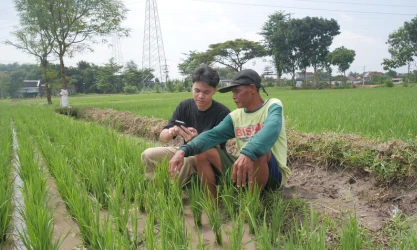
A part of Edufarmers’ core funding goes toward our internal agriculture research team, with a focus of testing innovative farming approaches that can improve farmers’ productivity. In August 2025, our research team designed and ran a full-season field trial in Klaten, Central Java to compare AWD directly against conventional practice, side by side, using the Inpari 32 variety that farmers in the region grow. We controlled for everything except irrigation: same nutrient management, same variety, same season.
A window to scale AWD In Indonesia
The 2026 dry season is creating a pivotal moment for rice farming in Indonesia. There is growing momentum, including emerging interest from the Government of Indonesia, to explore and utilize AWD as a climate risk mitigation strategy, which presents an opportunity to drive systemic change.
Edufarmers is actively working to further explore and pilot how AWD can be promoted in a way that is accessible for smallholder farmers. But more on-the-ground evidence on how AWD can be operationalized across different farm contexts, and farmer profiles is still needed to make a compelling case for national scale-up.
If you share this sense of urgency, we'd love to explore what's possible together, whether that's directing resources toward proven climate-smart interventions, co-designing field research to test these interventions or building the evidence base that helps convince policymakers to act.